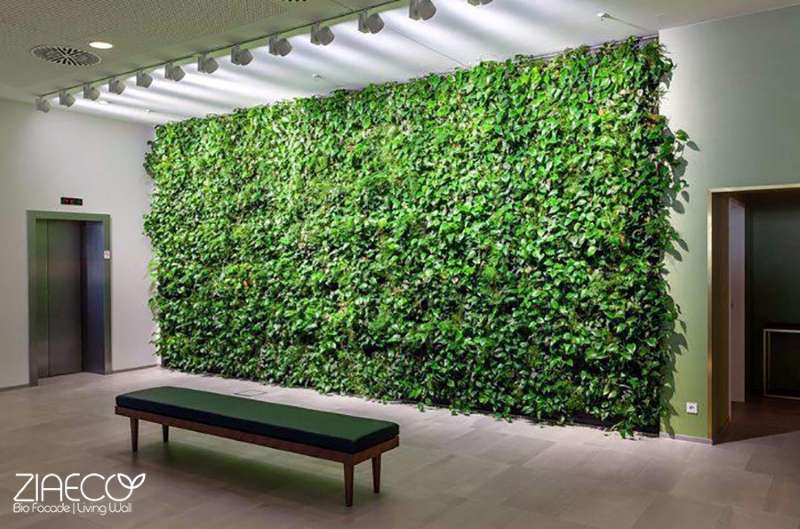
you the lush greenery you desire without the need for water, sunlight, or soil. However, despite its practicality, artificial green walls come with both advantages and disadvantages, which we will explore with you throughout this article.
What is an artificial green wall?
Green walls come in two main types: natural and artificial. They are installed vertically, either indoors or outdoors. Artificial green walls are made from a material called polyethylene, molded into shapes resembling green leaves and flowers. During manufacturing, polyethylene is melted and combined with special additives, then poured into window-like molds to create artificial plants.
Applications and Benefits of Artificial Green Walls
In recent years, artificial green walls have gained popularity due to their wide range of benefits, which we will introduce below:
- They enhance the aesthetic appeal of a space.
Thanks to artificial plants and flowers and the wide variety of colors, artificial green walls create a stunning and pleasing environment. With the help of lighting, the visual effect becomes even more impressive.
- They cover old and worn-out walls.
Walls naturally wear out over time. Installing an artificial green wall restores freshness and charm to the space. They can also be used to beautify protective railings.
- They promote a sense of happiness and calmness.
The color green evokes freshness, joy, and tranquility. Even though the plants are artificial, they still transfer a considerable amount of that natural vitality to humans.
- They come in a wide variety of designs.
One major reason for their popularity is the diversity in colors, patterns, and plant types. Interestingly, even plants that only grow in specific climates can be replicated in artificial green walls, allowing you to enjoy the sight and feeling of rare species.
- They are lightweight.
Since these walls are often used on old surfaces, heavy materials are not suitable. The plastic structure means they require no soil and remain lightweight.
- They are suitable for tall installations.
Because they don’t require soil and weigh very little, artificial green walls are easy to use at high elevations.
- They are cost-effective.
Real plants can be expensive, but artificial green walls are far more budget-friendly. Their price varies depending on design and size, but they generally remain affordable.
- They are easy to install.
Only basic tools like screws, nails, anchors, and glue are needed. Their lightweight and low cost make them simple and accessible for installation.
- They are resistant to sunlight and heat.
Thanks to special additives mixed with polyethylene, artificial plants maintain their color and durability under direct sunlight, resisting UV rays. And, of course, they never wilt.
- They require no maintenance.
Unlike natural plants, artificial green walls need no soil, water, sunlight, fertilizer, or pruning. No gardeners required.
- They provide thermal insulation.
Due to their polyethylene composition, they help prevent heat transfer. In winter, they keep cold out, and in summer, they block heat—useful especially in building lobbies.
- They provide sound insulation.
Artificial green walls reduce sound penetration. Polyethylene acts as a sound barrier, and the uneven textured surface scatters sound frequencies, making them suitable for loud environments.